Talk
Fri, 9 Oct · 12:30 pm · Bengaluru
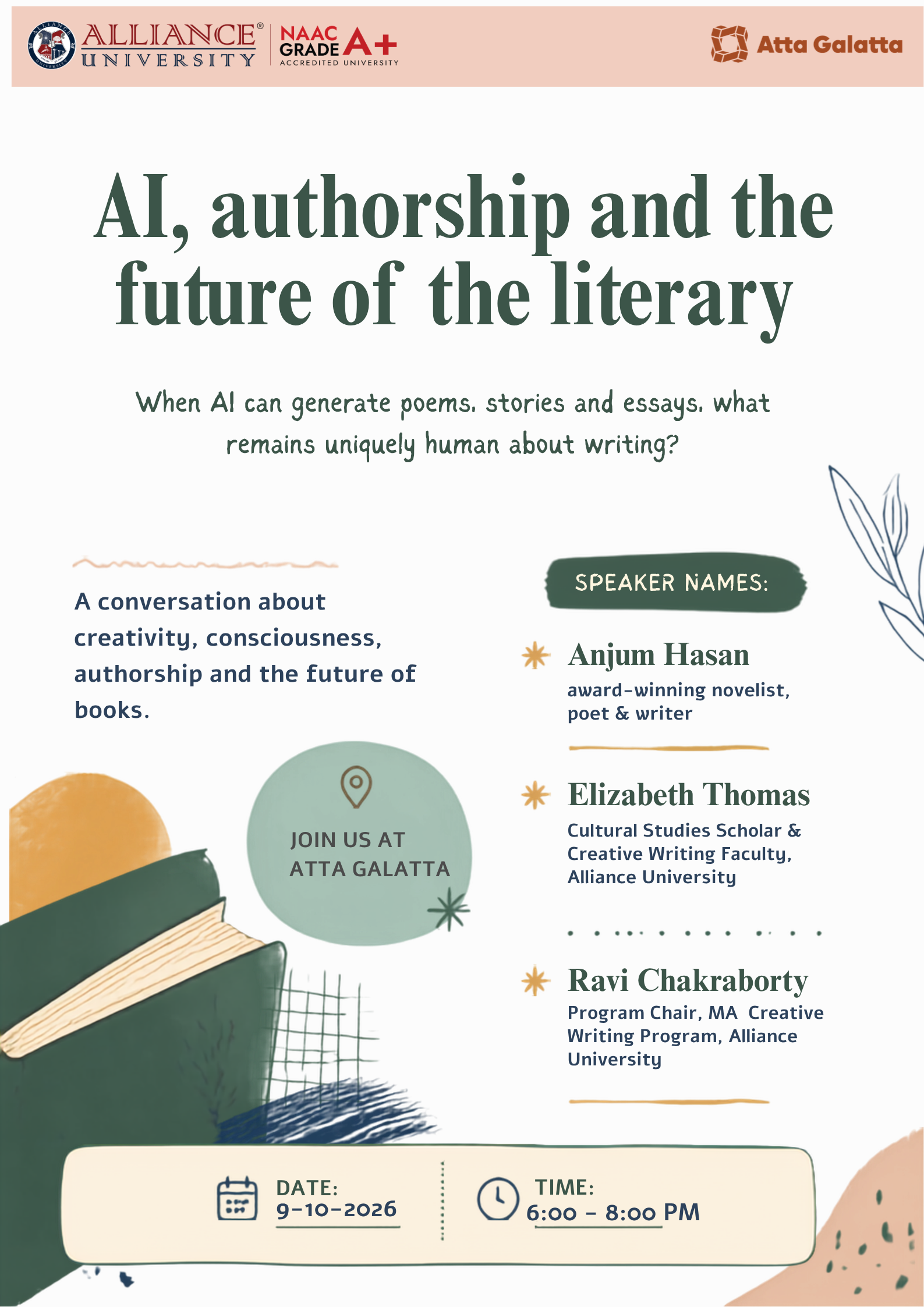
AI, authorship and the future of the literary
About
A conversation about creativity, consciousness, authorship and the future of books.
A poem in seconds. A story at the click of a button. Research, rewriting, imitation, ideas on demand.
If a machine can now do so much of what we associate with writing, what exactly are writers doing?
And what happens to the things that cannot be reduced to a prompt: the particularity of a place, the accumulation of experience, the strange things that catch our attention, the forms we fall in love with, the discoveries we make while trying to write?
AI, authorship and the future of the literary brings together celebrated Writer, poet and essayist Anjum Hasan, literary and cultural studies scholar Elizabeth Thomas, and Ravi Chakraborty, Programme Director of Alliance University's MA Creative Writing programme, for a lively roundtable on writing in the age of AI.
The conversation will move across fiction, poetry, nonfiction, screenwriting and other forms of storytelling, asking what changes when AI enters the picture. We will talk about literary consciousness and imitation, originality and authorship, research and discovery, and the choices writers make before, during and after putting words on the page. We will also look at what AI means for publishing: for writers, editors, publishers and readers, and for the idea of the book as something made through many kinds of human labour.
For a programme that teaches people to write, AI also presents a more immediate question: what should we be teaching writers now? What kinds of attention and experimentation become more important when machines can generate language so easily? Can close observation of one's environment, encounters with other forms and sustained experimentation become ways of developing a voice that cannot simply be prompted into existence?
And perhaps the most interesting question is not whether AI will replace writers, but what we might discover about writing by being forced to ask what only writing, and writers, can do.
The roundtable will be genuinely open, with questions and interventions from the audience woven into the conversation.
At Atta Galatta, a space built around the physical book, the conversation will also touch on the curious fact that a book is never just words: it is a work shaped by writers, editors, designers, publishers and readers, and by the many human decisions that bring it into the world.
Come with your questions. Your doubts about AI. Your enthusiasms. Your arguments about what counts as writing.
Also on